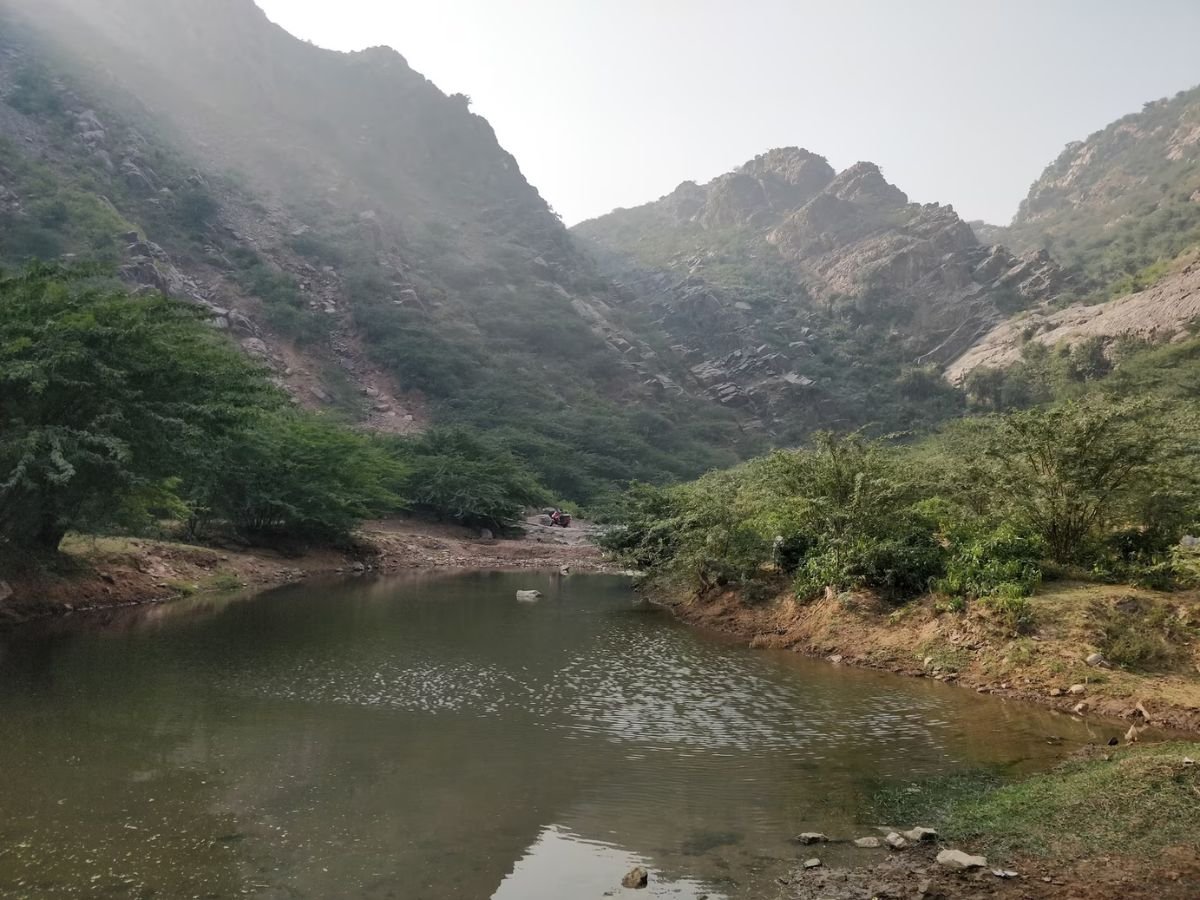
Bawal is a working industrial town in Rewari district, Haryana — a stop on NH-48 rather than a classic sightseeing destination. It has two genuinely interesting things to see: a 19th-century fort and a wetland that fills with migratory birds every winter. Around those, you get ordinary, unpolished Haryana town life. This guide covers what is actually in Bawal, what is only nearby, and how to plan the visit honestly.
🏰 A fort from the 1870s🦆 Winter birdwatching wetland📍 On NH-48, about 11 km from Rewari🛕 Small-town markets & temples
🗓️ Information last reviewed: September 2026
What are the best places to visit in Bawal?
The list is short, and it is better to say so. Inside Bawal itself, the standout places are the Fort of Bawal — a slate-and-stone structure built in the 1870s and partly used as a police station today — and the HSIIDC Bawal wetland, where thousands of migratory birds arrive between November and February. After that, the interest is in the town itself: its market lanes, small temples and highway dhabas. Bawal is best treated as a half-day stop and combined with Rewari, about 11 km away, or Neemrana to the south.
Where is Bawal and what can you expect?
Bawal is a town and tehsil headquarters in Rewari district, Haryana, inside the National Capital Region. It sits directly on NH-48 (the old NH-8) — the highway that runs from Delhi through Gurugram and Dharuhera towards Neemrana, Jaipur and onward to Mumbai. Bawal is roughly 11 km from Rewari, 50 km from Gurugram and about 90 km from central Delhi. Its PIN code is 123501 and the town stands at about 266 metres above sea level.
The first thing to understand is what kind of place Bawal is. It is an industrial town, not a tourist town. The HSIIDC Industrial Model Township (IMT) Bawal was developed from the mid-1990s and now hosts a large cluster of auto-component and manufacturing units, which is why the highway edges look like an industrial belt. Historically, the town belonged to the Jhajjar princely state before the upheaval of 1857. Afterwards it passed to the Nabha chief Hira Singh, who built a fort here in 1875. Bawal tehsil was later one of the three districts of the erstwhile Nabha State under British rule.
So come with the right expectation. You will not find a ticketed monument complex, a lake promenade or a curated heritage precinct. What you will find is a real, busy small town with a crumbling fort, a surprising wetland on its industrial edge, and honest local food. If that sounds interesting, Bawal rewards a few unhurried hours — especially in winter.
Bawal at a glance
Distances are approximate road distances from the town centre and can vary by route.
Where it is
Rewari district, Haryana (NCR), on NH-48
Nearest cities
Rewari (~11 km), Gurugram (~50 km), Delhi (~90 km)
Main attractions
Fort of Bawal; HSIIDC Bawal wetland; town markets and temples
Best for
A half-day heritage and local-market stop, winter birdwatching, a break on the Delhi–Jaipur drive
Time needed
2–3 hours for the town; a full day if you add Rewari or spend time birding
Best season
October to March; December–February for the birds
Getting there
Road (NH-48); rail (Bawal station, code BWL, on the Rewari–Alwar line); air via Delhi IGI (~75 km)
Pairs well with
Rewari, Neemrana, Gurugram, Jhajjar
Places to Visit in Bawal
Everything below is actually in or immediately around Bawal town. Nearby Rewari, Neemrana and Gurugram are covered separately further down, because those are different places and should not be mixed up with Bawal.
1 Fort of Bawal
The fort is Bawal's one piece of built heritage. It was raised in 1875 by Hira Singh, the Nabha chief who took control of the town after the events of 1857. It is built of slate and stone masonry, typical of the region's construction in that period.
Be clear about what you are visiting: this is a heritage structure in use, not a managed monument. According to Haryana Tourism, the fort's three-sided walls and rear gateway are in satisfactory condition, while the front portion has partly fallen. Part of the surviving structure functions as a police station, so it is a working government building and access inside is not open to visitors in the way a museum would be.
For a traveller, this means the fort is worth a short stop to see a genuine 19th-century masonry structure and understand the town's link to the Nabha state — a bit of history most visitors to the Delhi–Jaipur highway never notice. There are no published timings or entry fees from official sources, so treat it as a look-and-learn stop and ask locally before assuming you can walk in.
Best for: history and architectureTime: 20–30 minutesNote: partly in use as a police station
2 HSIIDC Bawal Wetland — the winter birding spot
This is the surprise of Bawal, and for many visitors the real reason to come. In the eastern part of the HSIIDC industrial estate, between the factory belt and Baba Pachpir Temple, a wetland forms that draws more than 4,000 migratory birds of around 50 species each winter, arriving from Siberia, Mongolia, Alaska and other far-off regions.
The bird list recorded here is genuinely varied: wagtails, common teal, pintail, northern shoveller, garganey, Eurasian coot, redshank, common and wood sandpipers, marsh sandpiper, Kentish and greater sand plovers, little ringed plover, white-tailed lapwing, greater flamingo, common and ferruginous pochard, gulls and pied avocet. The rare Pacific golden plover, a species that breeds in western Alaska, has also been recorded at the site.
Set your expectations properly. This is a functional industrial-estate wetland, not a nature reserve with boardwalks, hides or cafés. There is no ticketing, no visitor centre and no published opening hours. Bring binoculars, wear shoes you don't mind getting dusty, and keep a sensible distance from the water. Early morning light is best. Bird numbers peak in the cooler months and drop off sharply once the weather warms.
Best for: birdwatchers, photographersSeason: November–FebruaryBring: binoculars, water, sturdy shoes
3 Bawal's old town — markets, temples and street food
Bawal's town core is the everyday part of the visit, and for some travellers the most enjoyable one. The market lanes around the town centre are busy with local trade, cloth and household shops, sweet shops and tea stalls, and small Hindu temples tucked between buildings. Baba Pachpir Temple, near the eastern industrial estate, is one of the town's better-known local shrines and is easy to pair with a wetland visit.
This is not a heritage bazaar like Rewari's brass market — it is a normal working town market, which is exactly why it feels authentic. Go for a walk, eat what looks freshly made, and buy nothing you don't need. Sunday mornings and weekday evenings are the liveliest times.
Best for: local life and foodTime: 45–60 minutesCost: free to walk
4 The Sahibi river belt — only worth it after the rains
The Sahibi (also called the Sabi) is an ephemeral, rain-fed river that drains parts of Alwar in Rajasthan and the southern Haryana districts including Rewari. For most of the year it is a dry, sandy course rather than a river you would go and look at.
Honest advice: treat this as a driving countryside experience, not an attraction. After a good monsoon, the belt around Bawal greens up, and the contrast with the dry-season landscape is striking. Outside that window, there is little reason to seek it out. Do not plan a trip around it.
Best for: a scenic driveWhen: July–September, after rainSkip if: the season has been dry
A straight answer: Bawal has a short list of conventional attractions. Rather than pad the page, it is more useful to plan Bawal as one stop in a wider south-Haryana day and lean on Rewari for the bigger sights — see places to visit in Rewari, about 11 km away.
Things to Do in Bawal
Because Bawal is a small town, "things to do" here means a handful of simple, specific activities rather than a checklist of attractions.
See the Fort of Bawal and read up a little on the Nabha connection before you go — the 1875 fort is far more interesting once you know who built it and why.
Go birdwatching at the HSIIDC wetland in winter. This is the single best thing to do in Bawal between November and February.
Eat on the highway. The NH-48 stretch around Bawal is lined with dhabas serving standard North Indian and Haryanvi food. They are a normal part of a road trip here.
Walk the town market for local sweets, tea and everyday shopping — a genuinely local experience, not a tourist one.
Do a countryside loop after the monsoon along the Sahibi belt, when the fields are green.
Pair Bawal with Rewari if you want a fuller day: the Rewari steam locomotive shed and museum is the biggest draw in the district and is only a short drive away.
What you should not expect in Bawal: adventure parks, boating, a lakefront, a managed garden, or a big temple complex. None of those are part of what Bawal actually is, and it is better to plan around that.
Is Bawal Good for a Short Trip?
Yes — but for a specific kind of short trip. Bawal works well as:
A highway break. If you are driving the Delhi–Jaipur route on NH-48, Bawal is an easy place to stop, eat and stretch, with the fort as a bonus.
A half-day outing. Fort plus town market plus a meal is a comfortable half day. Two to three hours is enough for the town itself.
A day trip with birding. In winter, adding a couple of hours at the wetland turns Bawal into a genuine full-day outing for anyone interested in birds.
Part of a longer south-Haryana circuit. Bawal sits naturally between Rewari, Dharuhera and Neemrana, so it slots into a wider drive rather than standing alone.
Where Bawal does not work is as a standalone weekend destination. There is not enough to see for two full days on its own. It becomes worthwhile when combined with Rewari and Neemrana.
Places Near Bawal
These are not in Bawal. They are separate towns and destinations that make sense to add to a Bawal trip because of geography. Distances below are approximate road distances and depend on the route you take.
Rewari — the closest and the most rewarding
Rewari is the district headquarters, about 11 km from Bawal, and it is where you find the region's best-known sight: the Rewari steam locomotive shed and railway heritage museum, along with the old brass bazaars and the city's 1857 history connected to Rao Tula Ram. If you are visiting Bawal at all, Rewari is the natural add-on. Read our guide to.
Neemrana — half an hour south, into Rajasthan
Neemrana lies across the state border in Rajasthan, roughly 24 km south-west of Bawal by road according to route estimates for the corridor. The main draw is the restored Neemrana Fort-Palace heritage property and the stepwell restored there — a very different experience from Bawal's ruined fort. It makes an easy half-day extension if you are already driving this stretch of NH-48. There is no dedicated page for it on this site yet, so we are not linking one.
Masani barrage wetland — for serious birders
Around 15 km from the Bawal wetland, Masani barrage is a water-management structure on the Sahibi system that has become a large wintering ground for migratory and resident water birds, with bird counts far higher than at Bawal. If you are coming specifically for birds, plan Bawal and Masani together. Note that this is a working barrage, not a park — and access depends on local conditions, so check before you go.
Gurugram — the big-city option
Gurugram is about 50 km north on NH-48, so it is usually the origin or the end of a Bawal trip rather than a stop in the middle. If you want shopping, dining and city comforts around a south-Haryana drive, see our guide to things to explore in Gurgaon.
Jhajjar — for the district's older history
Jhajjar, north-west of Bawal, is the princely state that Bawal itself belonged to before 1857 — which gives the connection some genuine historical logic. It is a longer drive and suits travellers who are already exploring the Rewari–Jhajjar–Rohtak belt rather than first-time visitors. See Jhajjar.
Manesar — for a stay or a day outing
Manesar sits on the same NH-48 corridor, roughly an hour's drive north of Bawal. If you want to turn a Bawal stop into an overnight break, the resort and farmhouse belt around Manesar is the practical base. Browse picnic spots around Manesar or the main list of resorts in and around Manesar.
How to Reach Bawal?
By road
Bawal is directly on NH-48. Coming from Delhi or Gurugram, you drive south past Manesar and Dharuhera and reach Bawal after Rewari district begins. NH-352 (the old NH-71, from Rohtak and Jhajjar via Rewari) terminates on NH-48 about 10 km north of Bawal, which is why the town is easy to reach from several directions. State buses and private cabs run along the highway corridor throughout the day. Actual travel time depends heavily on traffic near Gurugram, so leave a buffer.
By train
Bawal has its own railway station, Bawal (station code BWL), on the Rewari–Alwar line. Several passenger trains connect Bawal with Rewari each day — a short run of about 15 km, though timings change with the railway timetable, so check current schedules before planning around a train.
By air
The nearest airport is Indira Gandhi International Airport, Delhi, about 75 km away. From there, Bawal is a road journey down NH-48.
Getting around locally
Within Bawal, auto-rickshaws and shared autos are the usual way to move about, and the town core is walkable. For the fort, the wetland and anything outside the centre, having your own vehicle or a hired cab for a few hours is far more practical than relying on local transport.
Best Time to Visit Bawal
Bawal has a typical north-Indian plains climate: hot, dry summers and cool winters. Average temperatures here have been recorded from about 9°C in January to around 41°C in June, with May and June the hottest and driest months.
October to March — the comfortable window. Pleasant days for the fort, the town market and any walking. This is when most visitors should plan a Bawal trip.
December to February — the best time if birds are your reason for coming. Migratory species are on the wetland in numbers, mornings are cool and clear, and light is good for photography. Carry a jacket for early starts.
April to June — very hot. Sightseeing in the middle of the day is uncomfortable, and bird numbers fall away. If you must travel now, keep it to early morning and evening.
July to September — humid with monsoon rain, and the period when the Sahibi actually carries water. Roads can be messy and the wetland is not at its best, but the countryside is at its greenest.
One caution: Bawal is not a seasonal tourist town in the way hill stations are. There is no festival season that transforms it, and no peak crowd period to avoid. Winter simply happens to be the most pleasant and the most rewarding time to be here.
How Long Do You Need in Bawal?
Base this on what is actually here, not on a wish list.
2–3 hours: the Fort of Bawal plus a walk through the town market and a meal. This is enough to see Bawal itself.
Half a day: add a leisurely market visit, tea stops and a slow drive around town. Comfortable and unhurried.
A full day: only makes sense in winter, when you can pair the fort and town with a proper birding session at the HSIIDC wetland, or with a trip to Rewari's railway museum.
Two days: not worth it for Bawal alone. Use it as a base only if you are also covering Rewari, Neemrana and the Manesar resort belt.
Bawal Trip Planning
Start with the fort, then the town. Do the heritage stop first while it is cool, then walk the market when the shops are properly open.
Treat Rewari, Neemrana and Gurugram as separate trips. They are different towns with their own sights. Do not expect to see "Bawal plus everything nearby" in one rushed afternoon.
Confirm access before you go. The fort is partly used as a police station and the wetland is inside an industrial estate — neither has published visitor timings. A quick local enquiry saves a wasted trip.
For birding, come early, come in winter, and bring binoculars. There are no facilities at the wetland, so carry water and snacks.
Plan road travel around real traffic. The NH-48 stretch near Gurugram and Dharuhera can slow badly in peak hours, so keep your schedule flexible.
Pack for the season. Light cottons and sun protection from April to September; a jacket and warm layers from December to February, especially for early morning birding.
Keep some cash on you. Small shops, tea stalls and local autos are easier to deal with in cash.
If you need to stay overnight, look at the Manesar resort belt an hour up the highway rather than expecting hotel choice inside Bawal.
Frequently Asked Questions
The best places to visit in Bawal are the Fort of Bawal, built in 1875 of slate and stone masonry, and the HSIIDC Bawal wetland, which hosts thousands of migratory birds each winter. After those, the town's market lanes, small temples and highway dhabas are what there is to see. Bawal has a genuinely short list of attractions, so most travellers visit it as a half-day stop.
Not a great deal. Bawal is an industrial town on NH-48, and it does not have a ticketed monument complex, a lake or a managed garden. Its two real sights are the 19th-century fort and the winter birding wetland, both of which are modest in scale. The honest approach is to plan a few hours for Bawal and rely on Rewari, about 11 km away, for the district's headline attractions.
See the Fort of Bawal and learn about its Nabha state connection; go birdwatching at the HSIIDC wetland between November and February; walk the town market for local sweets, tea and everyday shopping; eat at one of the highway dhabas on NH-48; and, after a good monsoon, drive the Sahibi river belt when the fields are green.
Rewari is the closest at about 11 km and has the district's main attraction, the steam locomotive museum. Neemrana is roughly 24 km south-west by road, across the Rajasthan border. Masani barrage wetland, about 15 km from the Bawal wetland, is better for serious birders. Gurugram is around 50 km north and Jhajjar lies further to the north-west. All of these are separate destinations, not places inside Bawal.
By road, Bawal is on NH-48, so it is a straightforward drive from Delhi or Gurugram, and buses and cabs run along the corridor all day. By rail, Bawal has its own station (code BWL) on the Rewari–Alwar line, with several trains a day to Rewari, about 15 km away. The nearest airport is Delhi's Indira Gandhi International Airport, roughly 75 km away.
Two to three hours covers the Fort of Bawal, a walk through the town market and a meal. Half a day gives you a relaxed version of the same. A full day only makes sense in winter, when you can add a birding session at the HSIIDC wetland or a trip to Rewari's railway museum. Bawal on its own is not a two-day destination.
Winter, from late November to February. That is when more than 4,000 migratory birds of around 50 species are recorded at the HSIIDC Bawal wetland, arriving from regions as far as Siberia, Mongolia and Alaska. Early mornings give the best light and the most activity. Bird numbers drop sharply once the weather warms towards summer.
Rewari is the most natural pairing, at about 11 km, and works for almost any traveller. Rewari plus Neemrana makes a solid south-Haryana day if you are driving NH-48. In winter, pair Bawal with Masani barrage for birds. Gurugram and the Manesar resort belt to the north are better as the starting point or an overnight base than as an add-on to a short Bawal visit.